


The TAWWER platform, the Emirates Research and Development Council’s digital system for obtaining mandatory pre-approval of R&D projects, went live on 21 October 2026 and is now accepting applications.
For businesses carrying out innovation in the UAE, this is a significant practical development. Unlike the largely retrospective self-assessment processes in the UK, Ireland and the USA - where claims are typically prepared and submitted after year-end (or, in the USA, even via amended returns for open years) - the UAE regime requires projects to be pre-approved before they can form part of a claim. TAWWER is the route through which that approval must be sought.
Why pre-approval changes the timeline
Pre-approval from the Emirates Research and Development Council is a mandatory condition for claiming the R&D Tax Credit. Without it, a project cannot be included in a Corporate Tax or Top-up Tax return. The underlying technical principles will be familiar to businesses with experience of other regimes: qualifying activity must be novel and creative, address uncertainty, be undertaken systematically, and produce results that are transferable or reproducible (assessed having regard to the Frascati Manual). Activities must also be carried out in the UAE.
The practical effect is that the technical narrative and supporting evidence need to be developed while projects are underway, rather than reconstructed after year-end.
Pre-approval deadlines - the critical window
Missing the pre-approval window means a project cannot be included in a claim for that period. This is therefore one of the most important timing requirements under the regime.
The R&D Tax Credit applies to tax periods commencing on or after 1 January 2026. Applications for pre-approval are submitted through TAWWER. The platform confirms the following rules:
- Applications relating to periods ending on or before 31 December 2026 must be submitted within 40 business days of the period end.
- Applications relating to periods ending after 31 December 2026 must be submitted on or before the last day of the period itself.
A transitional rule applies to periods ending on or before 31 December 2026. As a result, a January 2027 year-end has an earlier absolute deadline than a December 2026 year-end. The January 2027 period must be submitted by the last day of the period itself, whereas December 2026 benefits from the 40-business-day window after period end.
Illustrative pre-approval submission deadlines
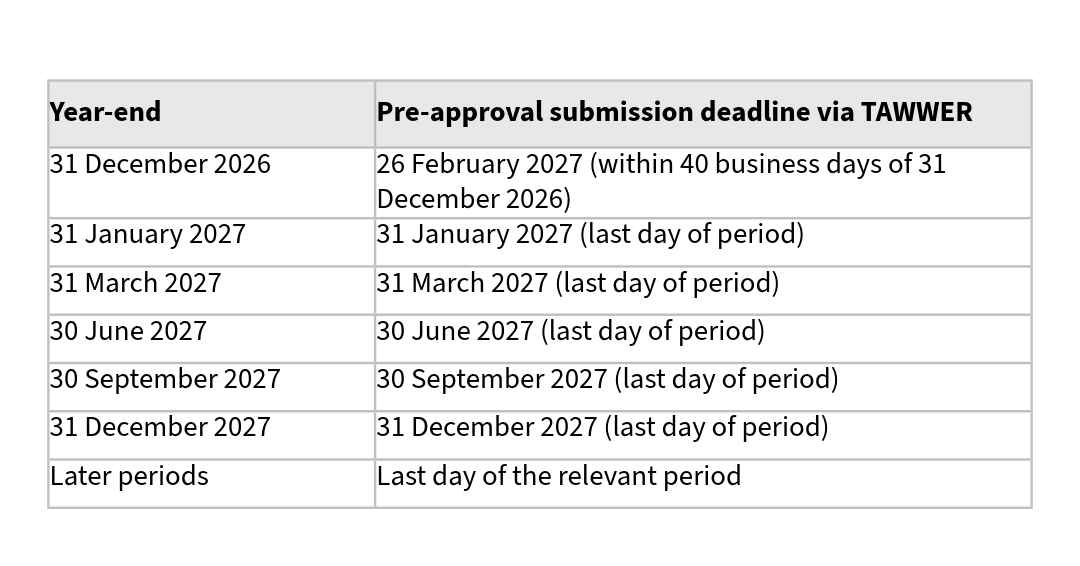
These deadlines apply only to the pre-approval process on TAWWER. They are separate from the later steps required to claim the credit itself.
From pre-approval to the tax return
Once pre-approval has been obtained, the actual R&D Tax Credit claim is not submitted through TAWWER. It is made as part of the business’s Corporate Tax return (or Top-up Tax return) via the Federal Tax Authority’s Emaratax platform.
Expenditure confirmation is required within six months of year-end. The claim itself, supported by proof of pre-approval, a senior management declaration, a breakdown of qualifying expenditure and audited financial statements, must be included in the tax return and filed by the normal Corporate Tax filing deadline (typically nine months after the end of the tax period - for example, 30 September for a 31 December year-end).
What to prepare for a robust application
A clear technical narrative remains central. Businesses need to set out the objectives of the project, the technical uncertainty faced, the alternatives considered, and the systematic work undertaken to resolve it. Supporting evidence can include design files, test results, method statements, sprint records, CAD, commissioning data and change logs.
Other practical points include:
- Each R&D project must meet a minimum qualifying expenditure threshold of AED 500,000 in the relevant tax period (measured before any staff-cost uplift). Projects below this level will not qualify.
- Credit rates are tiered (15%, 35% and 50%) and depend on both the level of qualifying expenditure and the average number of R&D staff. Both the expenditure and staffing thresholds must be met to access a higher band.
- There are rules around R&D staff location and supervision; only certain costs for staff located in the UAE under the relevant conditions qualify.
- In tax groups or certain other structures, the application is typically submitted by the parent or designated entity.
- Proof of pre-approval must later accompany the claim filed with the Federal Tax Authority.
Planning implications
The key operational difference is timing. In the UK, Ireland and the USA, businesses can generally prepare much of the technical file retrospectively (subject to specific notification, form or amended-return requirements). The UAE requires the technical story to be developed while the work is underway so that a robust application can be submitted through TAWWER within the required window.
This also interacts with other reliefs. Businesses that elect for Small Business Relief cannot claim the R&D Tax Credit for the same tax period. For growing companies investing in innovation, assessing the relative value of each option early is important.
Looking ahead
The R&D Tax Credit is still developing. Phase 1 is non-refundable and subject to an overall qualifying expenditure cap of AED 5 million per tax period (with a maximum credit of AED 2 million). Phase 2 is expected to consider possible enhancements. Regardless of future changes, businesses that establish strong, contemporaneous technical records now will be better placed both for current applications and for any evolution of the regime.
How CBTax can help
At CBTax, our UAE team supports businesses in identifying qualifying R&D activities, assessing the potential value of the credit, preparing the technical narrative and evidence required for pre-approval via TAWWER, and compiling the subsequent claim. Early engagement helps ensure projects are structured and documented in a way that meets the Council’s requirements.
If your business is carrying out or planning R&D in the UAE and you would like to understand how the pre-approval process applies, speak to our experts.