


Robotics & Automation
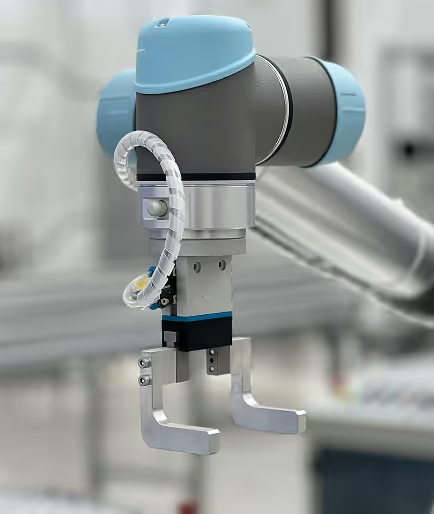
Within Robotics & Automation, a broad range of activities may qualify for R&D Tax incentives where competent professionals are seeking a technological advance and the solution is not readily deducible. This can include developing or materially improving robotic cells, end-effectors and tooling, as well as resolving uncertainty in control systems, motion stability, and accuracy or repeatability under real production constraints. It may also include integrating robots with PLCs, vision and sensing, safety systems and legacy equipment where standard interfaces, communications, or timing tolerances do not deliver reliable outcomes, alongside advancing machine vision or sensing performance in variable environments such as changing lighting, reflective surfaces, occlusion, or inconsistent part presentation.
How our skillset can help you claim
The robotics and automation sector is driven by practical, system-level challenges, mixed product lines, constrained footprints, takt-time pressure, reliability targets and legacy plant integration, which often create genuine technological uncertainty beyond routine configuration. Our specialist team works directly with your engineers to identify the specific uncertainties being addressed, use test results to support the iterations made, separate qualifying development from standard installation or production activity and translate complex engineering work into a clear and compliant technical narrative supported by a defensible approach to cost capture, helping you secure funding to reinvest in further automation.
Project Examples
A technological advance could be developing a cell that can sustain throughput and positional accuracy despite frequent changeovers and inconsistent part presentation. The uncertainty typically sits in how fixturing, sensor feedback, and control logic interact to stabilise performance without reverting to manual rework.
The innovation could be the integration process itself, getting robots, PLCs, safety systems and peripherals to behave as one dependable sequence when standard interfaces and timing assumptions break down. The technological advance is demonstrated through iterative analysis and fault-state testing to prove-out communications stability, sequencing integrity, and reliable recovery under production conditions.
Projects may seek to extend vision capability, so detection and measurement remain repeatable in the presence of variable lighting, reflective surfaces, occlusion and surface finish variation. The technical challenge is establishing a sensing and calibration technological process that performs at speed without unacceptable false positives/negatives as conditions drift.
